
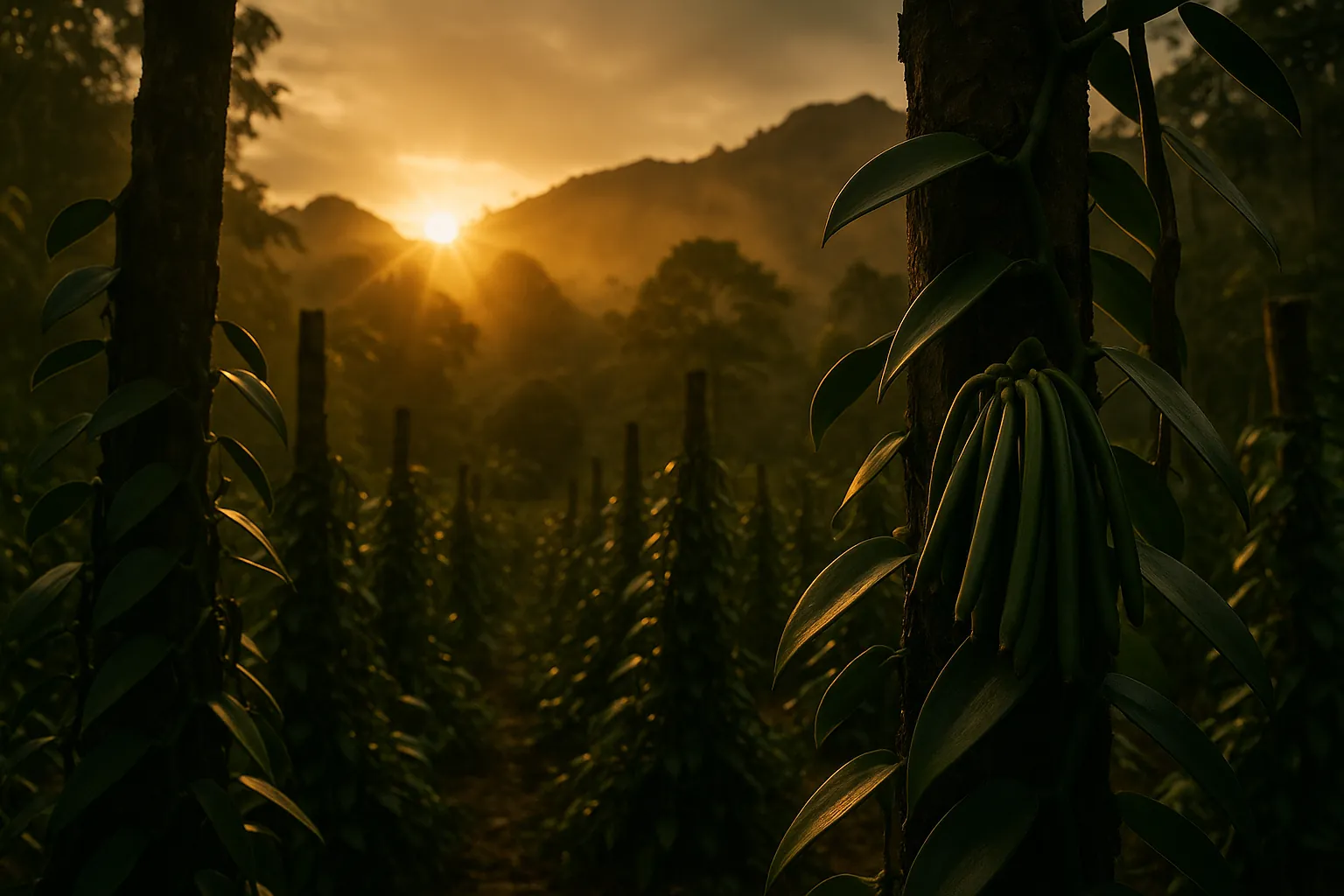
Vanilla is the most labour-intensive spice in the world, and nowhere is that clearer than in Madagascar's Sava region — the districts of Antalaha, Sambava and Vohémar in the island's north-east, which together supply the majority of the world's Bourbon vanilla. Every bean that reaches an importer has been touched by hand dozens of times: at pollination, at harvest, and through every stage of a cure that runs for months. Understanding that calendar tells a buyer a great deal about the bean they are about to receive — and why patience at origin is the single biggest driver of quality.
Pollination: one flower, one morning, one hand
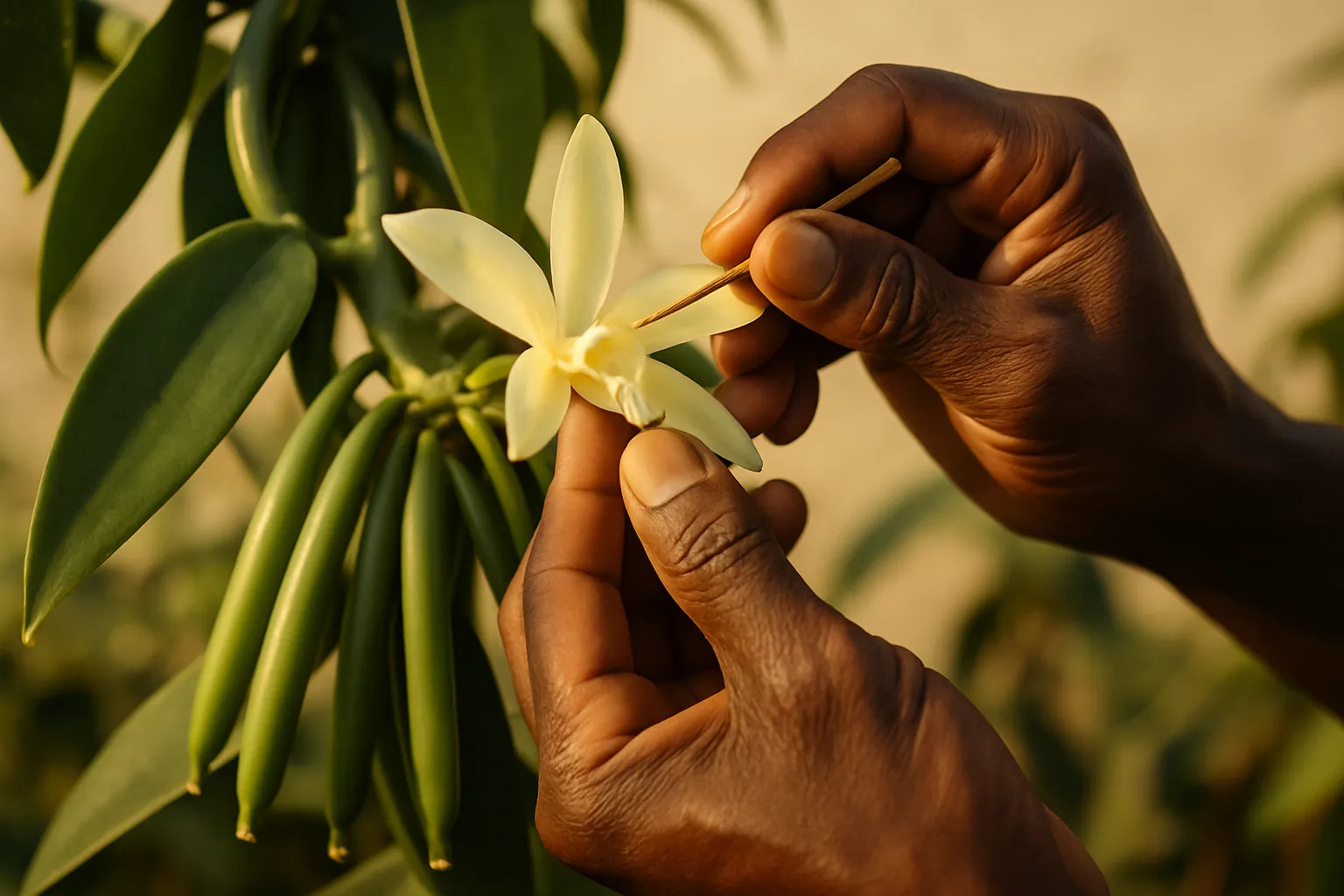
The vanilla orchid, Vanilla planifolia, arrived in Madagascar without its natural pollinator. The flower opens for a single morning — if it is not pollinated by early afternoon, it wilts and drops, and the chance is gone for that bloom. So between roughly October and December, growers walk their vines every morning of the flowering season, lifting the membrane that separates the flower's male and female parts with a sliver of bamboo and pressing them together by hand. A skilled worker pollinates several hundred flowers in a morning, and each successful pollination sets exactly one pod.
Growers also deliberately limit how many flowers they set per vine. Over-pollinated vines produce many thin, short pods; disciplined pollination produces fewer, fatter, longer beans — the 16 to 20 cm calibres that gourmet buyers pay for. When we assess a grower group, pollination discipline is one of the first things we ask about, because it decides the calibre profile of the harvest nine months before anyone picks a pod.
The green harvest: June to September
A vanilla pod spends eight to nine months maturing on the vine. Madagascar's green harvest opens between June and September, with official opening dates set district by district to discourage the picking of immature pods. A mature pod is plump, has lost its deep green gloss, and shows a faint yellowing at the tip. Picked too early, it will never develop full aroma no matter how well it is cured; picked too late, it begins to split on the vine.
“A green vanilla pod smells of almost nothing. Everything a buyer recognises as vanilla is made in the cure — which is why we put our supervision there.”
- Joachim Mbwana, Sourcing Lead
The cure: killing, sweating, drying, conditioning
Freshly picked green vanilla has no vanilla aroma at all. The flavour is locked up as glucovanillin, and the cure is the controlled enzymatic process that releases it. It happens in four stages, and each one has a failure mode that shows up months later in an importer's warehouse.
- Killing — the green pods are plunged into hot water at roughly 63 to 65°C for two to three minutes. This stops vegetative growth and starts the enzymatic reactions. Too hot or too long and the enzymes are destroyed; too cool and the pod keeps living and cures unevenly.
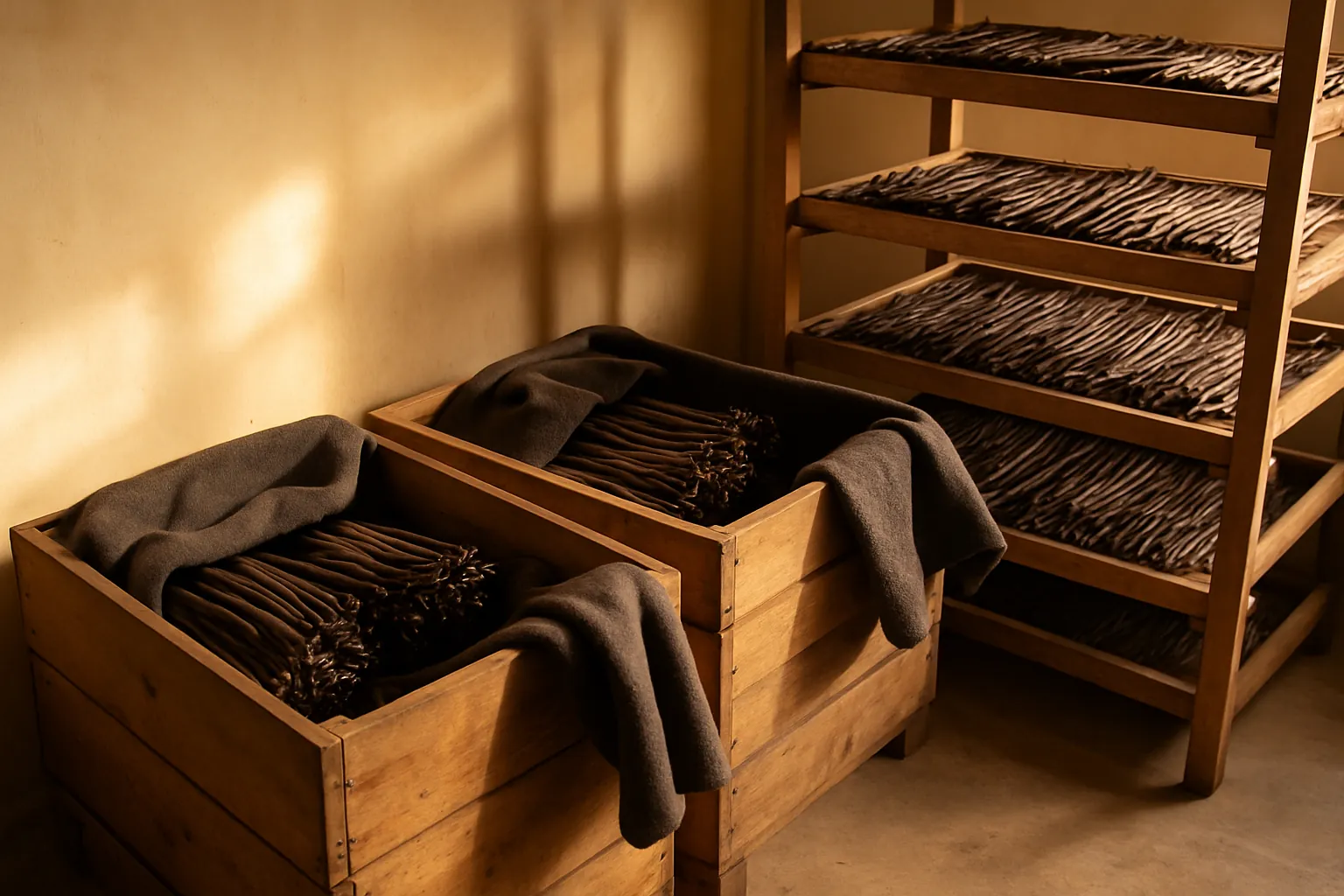
- Sweating — the killed pods are wrapped in wool blankets inside insulated boxes, where they hold heat for 24 to 48 hours at a time. The pods turn chocolate brown here as glucovanillin converts to vanillin. Sweating cycles alternate with short spells of sun for one to two weeks.
- Slow drying — beans are laid out on racks for a few hours of morning sun each day, then shaded, over three to four weeks. Rushing this stage traps moisture in the core of the bean — the single most common cause of mould claims.
- Conditioning — the dried beans rest in wax-paper-lined boxes for one to three months, developing the deep, rounded aroma profile that separates a fine Bourbon bean from a merely brown one.
Start to finish, the cure takes three to six months, and it concentrates the crop dramatically: it takes five to six kilograms of green pods to produce one kilogram of cured beans. When a quote for cured vanilla looks surprisingly cheap, that ratio is usually where the corner has been cut — under-cured, heavier beans carry more water and less aroma per kilogram.
What the calendar means for buyers
- New-cure Madagascar beans reach export condition from roughly November to January.
- The best gourmet calibres are allocated early — serious buyers reserve volume while the cure is still finishing.
- Cyclone season in the Sava region (roughly January to March) is the main supply risk to watch each year.
- Well-conditioned, vacuum-packed beans hold quality well past a single season, which is what makes year-round supply from conditioned stock possible.
We source directly from grower groups across Antalaha, Sambava and Vohémar, supervise curing alongside experienced curers, and tie every lot to its district and curing window. That is the traceability behind every Madagascar bean we ship — and it starts with a flower and a sliver of bamboo, nine months before the first lab test.
Related reading
Leave a Comment
Your email address will not be published.