
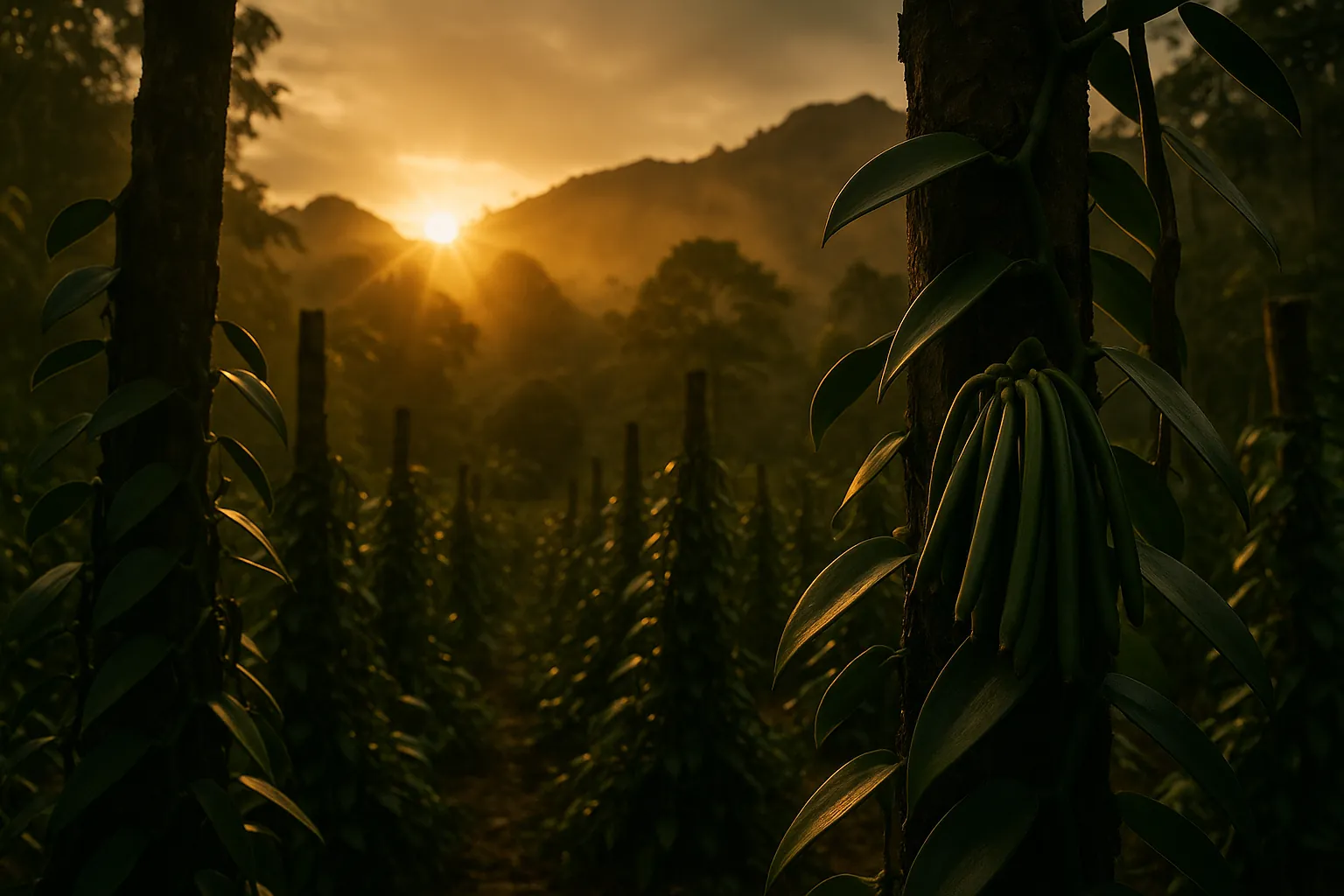
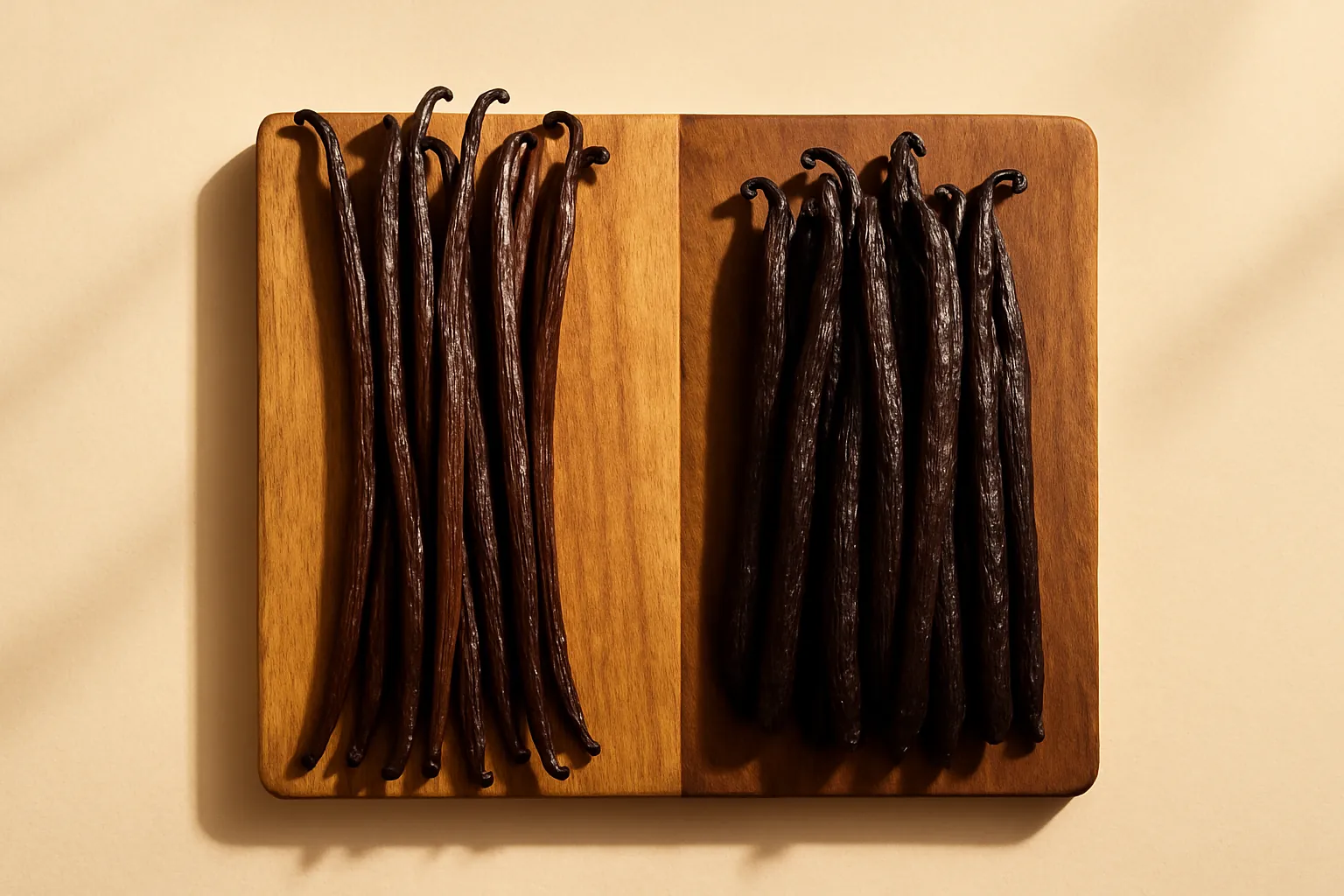
- Both origins grow the same species, Vanilla planifolia, and cure it in the same Bourbon tradition of hot-water killing, sweating and slow drying.
- Madagascar supplies the majority of the world's natural vanilla from the Sava region, with one harvest a year — green pods June–September, new cure from November.
- Uganda harvests twice a year (roughly December–February and June–August), putting fresh cure on the market in Madagascar's gaps.
- Sensory lean: Madagascar is creamy and sweet — the benchmark profile; Uganda is bolder and darker, with extraction lots assaying 2.0–2.6% vanillin.
- Uganda typically trades at a discount to Madagascar on comparable lab numbers — market structure and brand premium, not a quality gap.
- The strongest programmes use both origins: Madagascar for the front of the label, Uganda for continuity and cost.
We source from both Madagascar and Uganda, so we have no horse in this race — and buyers regularly ask us to call it anyway. The honest answer is that both origins grow the same species, Vanilla planifolia, and cure it in the same Indian Ocean 'Bourbon' tradition of hot-water killing, sweating and slow drying. The differences that matter to a buyer are structural: scale, calendar, flavour lean and price dynamics. Here is how we brief procurement teams on the choice.
Madagascar: the benchmark origin
Madagascar produces the majority of the world's natural vanilla, almost all of it from the Sava region in the north-east. That scale brings depth: the widest choice of calibres, the largest pool of experienced curers, and the sensory profile every flavour house calibrates against — creamy, sweet, rounded, the taste most consumers mean when they say 'vanilla'. Gourmet lots from a good Sava cure assay at 1.6 to 2.4% vanillin with the classic supple texture, and the long 18–20 cm calibres that premium retail wants come almost exclusively from here.
Madagascar's weaknesses are also structural. One origin supplying most of the world means concentrated risk: the Sava region sits in a cyclone corridor, and a single severe storm — as the trade learned in 2017 — can move global prices for years. The single annual harvest (green pods June–September, new cure from November) means the freshest beans arrive once a year, and speculative pressure around the campaign opening can be intense.
Uganda: the continuity origin
Uganda's vanilla comes mainly from Bundibugyo in the west and Mukono in the centre — and its defining structural advantage is the equatorial calendar: two flowering cycles, therefore two harvests a year, roughly December–February and June–August. For buyers, that means fresh cure reaching the market twice a year, neatly filling the gaps in Madagascar's calendar. Ugandan beans also tend to assay high — our extraction line runs 2.0 to 2.6% vanillin — with a bolder, darker profile that leans chocolatey and earthy against Madagascar's cream and sweetness.
Uganda's constraint is scale and curing infrastructure: a much smaller industry, fewer experienced curing houses, and historically more variable quality — which is precisely why supervision at origin matters more there, and why we invest our quality time in Bundibugyo sweating rooms as heavily as in Sava ones. Where that supervision holds, the results reward it: our Ugandan lots pass the same lab thresholds as the Madagascar programme, at a price the market has not yet caught up with.
What the price gap does and doesn't tell you
Uganda's discount to Madagascar is a market-structure fact, not a quality verdict. Madagascar carries the brand premium of the Bourbon name, the weight of buyer habit, and — in risky years — a cyclone premium priced into forward contracts. Uganda carries none of those, so a Ugandan lot that matches a Malagasy lot on vanillin, moisture and cure quality still trades cheaper. For buyers whose product never names an origin — most extract, most industrial flavour work — that gap is close to free money. For buyers whose label says Madagascar, it is irrelevant. Knowing which buyer you are is most of the decision.
Side by side for buyers
- Sensory profile — Madagascar: creamy, sweet, classic. Uganda: bold, chocolatey, high-impact.
- Vanillin — comparable ranges; Uganda's extraction grades often assay highest per kilogram.
- Calendar — Madagascar: one cure a year (Nov–Jan). Uganda: two harvests, fresh cure twice a year.
- Calibres — Madagascar offers the widest length choice including 18–20 cm premium; Uganda typically 15–18 cm.
- Price behaviour — Madagascar sets the world price and carries cyclone risk premium; Uganda usually trades at a discount with steadier availability.
- Best first use — Madagascar for retail and patisserie flagship lines; Uganda for extraction economics and supply continuity.
“The strongest vanilla programmes we supply don't choose an origin — they use Madagascar for the front of the label and Uganda for continuity and cost. Two origins is a strategy; one origin is a bet.”
- Asha Ngonyani, Quality Manager
Our recommendation
If your product leads with provenance and classic flavour, start with Madagascar Grade A and let the label say Sava. If you run an extract operation and price on vanillin per dollar, benchmark Uganda Grade B against your current supply — the assay numbers usually make the argument themselves. And if you buy at programme scale, qualify both: same species, same curing tradition, complementary calendars. We ship single-origin lots from each side, lab-tested and lot-tied, so a two-origin strategy never means blended anonymity.
Related reading

Leave a Comment
Your email address will not be published.