
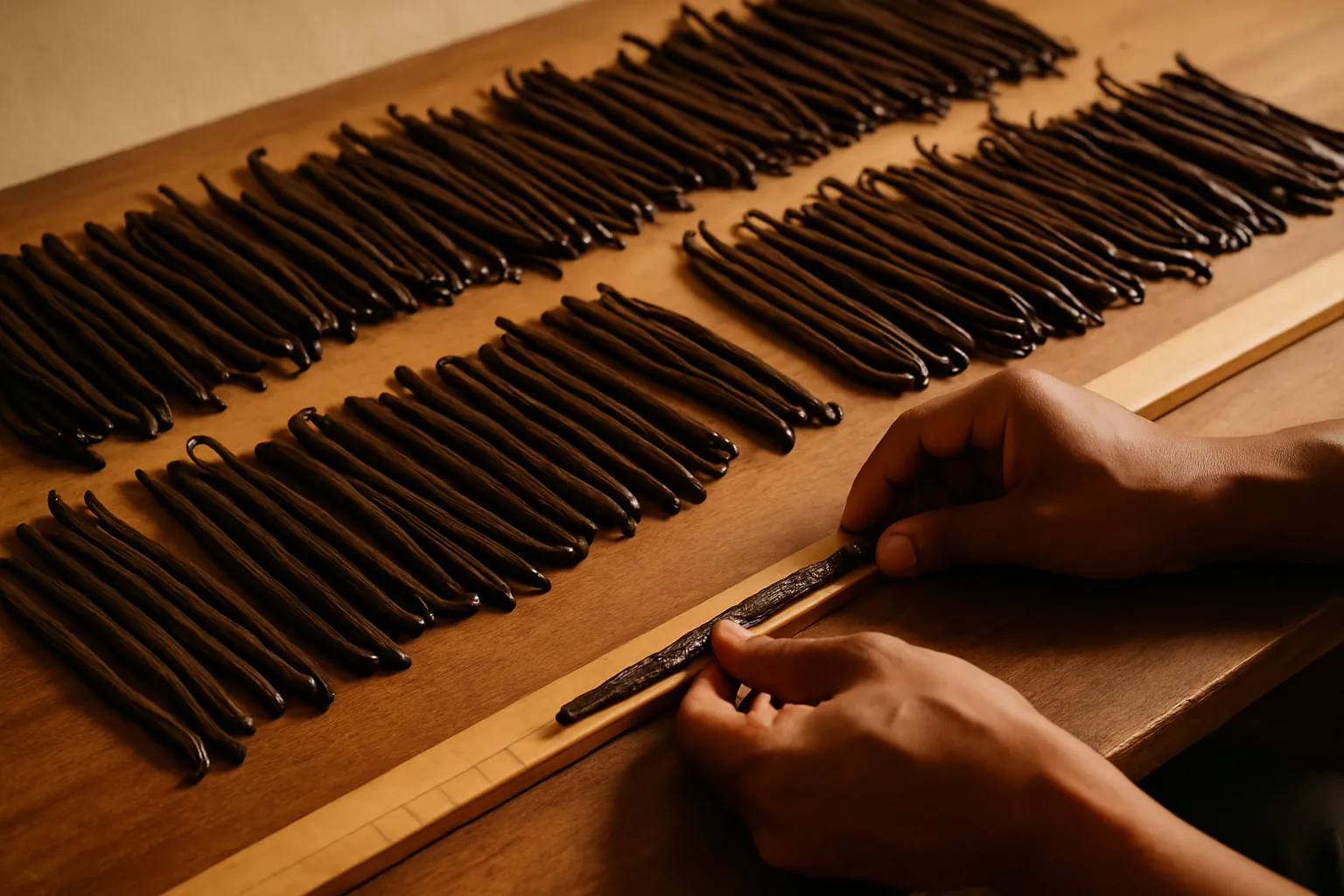
- Grade A / gourmet — the appearance grade: whole, supple, oily beans at 30–35% moisture, 15–20 cm, bought for retail packs and patisserie.
- Grade A long calibre — 18–20 cm, the presentation premium: bought when the bean itself is on display in a tube or on a menu.
- Grade B / extraction — the processing grade: drier beans at 20–25% moisture, 13–16 cm, bought on the vanillin assay for extract and flavour work.
- Short beans and cuts — under 14 cm plus clean cut pieces at 20–25% moisture: bought for high-volume extract runs and grinding.
- Vanilla bean powder — 100% ground cured beans at 6% moisture or below: bought for dry mixes, chocolate and clean-label ingredient decks.
- Moisture is set by grade, not by origin; vanillin ranges are set per lot by HPLC assay; length and bean count are set by calibration.
- A quotable specification names six things: grade and origin, length band, moisture band, vanillin range with method, condition tolerances and packing format.
This article is a chart, not an essay. For the narrative version — what the grades mean, where the labels came from, why TK sits between them — our companion piece on vanilla bean grades is linked at the foot of this page. What follows is the other half of the job: the numbers, grade by grade, so a buyer can match a specification to an order and write it into a contract without guessing.
Every figure below is a published range from our own catalogue, verified per lot by HPLC vanillin and moisture assay at origin. Vanilla is hand-graded, so these are bands with tolerances rather than promises of a single number — which is exactly why they belong in the contract.
How do you read a vanilla bean specification?
Five attributes describe any cured bean unambiguously. Length band sets the calibre and most of the presentation value. Moisture band sets the texture, the storage behaviour and the water fraction you are paying for. Vanillin range sets the flavour delivered per kilogram. Appearance — colour, oiliness, split or unsplit — separates an appearance grade from a processing grade. Packing format decides how the beans survive the journey. Grade names are shorthand for particular combinations of those five, and no international standard governs them: one exporter's Grade A is another's TK. Specify the attributes and the label stops mattering.
What does gourmet grade mean?
Gourmet — Grade A — is the appearance grade, bought with the eyes and the fingers as much as the nose: whole, unsplit, dark, oily, flexible enough to knot. The moisture band buys that suppleness and also makes the grade perishable, which is why gourmet beans ship vacuum-packed in one-kilogram pouches rather than loose in cartons.
- Grade: Grade A / gourmet — appearance grade
- Length band: 16–18 cm (Madagascar, and our organic Madagascar line) · 15–18 cm (Uganda) · 14–18 cm (Comoros)
- Moisture: 30–35% as we cure it; the wider trade band for gourmet runs roughly 25–35%
- Vanillin: 1.6–2.4% (Madagascar) · 1.8–2.2% (Uganda) · 1.4–2.0% (Comoros), by HPLC on a representative sample
- Bean count: ≈60–70 per kg (Madagascar) · ≈60–72 per kg (Uganda) · ≈65–80 per kg (Comoros)
- Appearance: uniformly dark chocolate-brown to black, visibly oily, whole and unsplit, pliable without cracking
- Packing: vacuum-packed 1 kg pouches inside export cartons
- Bought for: retail single-bean and gift packs, patisserie and ice-cream kitchens, premium extract and paste lines
What is the long-calibre gourmet band for?
Above the standard gourmet band sits a narrow premium tier defined purely by length — same cure, same moisture, same chemistry, hand-selected for calibre and straightness. Buyers pay for it when the bean is visible at the point of sale. There is no flavour argument for it.
- Grade: Grade A / gourmet, long calibre — presentation premium
- Length band: 18–20 cm, the longest calibre we cure
- Moisture: 30–35%
- Vanillin: 1.8–2.4% by HPLC
- Bean count: ≈55–65 per kg — the lowest piece count per kilogram in the range
- Appearance: hand-selected for length and straightness, uniformly dark, oily, unsplit
- Packing: vacuum-packed 1 kg pouches inside export cartons
- Bought for: glass-tube and premium retail presentation, high-end patisserie, hotel and restaurant supply
What does Grade B extraction mean?
Extraction — Grade B — is the processing grade, and nothing about it is aimed at the eye. The beans are cured further down, so they are firmer and drier, and the cosmetic tolerances open up: reddish-brown streaking, surface blemishes and a proportion of split tips are all inside spec. In a maceration tank none of that is detectable, and the drier bean carries more flavour per kilogram.
- Grade: Grade B / extraction — processing grade
- Length band: 14–16 cm (Madagascar) · 13–16 cm (Uganda)
- Moisture: 20–25%
- Vanillin: 1.8–2.6% (Madagascar) · 2.0–2.6% (Uganda — the highest assays in our catalogue)
- Appearance: firmer and drier to the hand, reddish-brown streaks and surface blemishes accepted, splits allowed within an agreed tolerance
- Packing: 5 kg vacuum-packed cartons
- Priced on: the vanillin assay, not appearance
- Bought for: vanilla extract production, flavour-house maceration, syrups, spirits and infusions
The trade also uses the label TK, or red, for the band immediately below gourmet — beans dried past the gourmet moisture range, showing red-brown colouring and sometimes a split tip. Exporters draw the boundary in different places and it almost always sells into extraction. Specify the moisture band and the assay, and TK becomes irrelevant.
Where do short beans and cuts fit?
Short-and-cuts is a size classification, not a quality one: sound beans that came off the vine under 14 cm, plus the clean cut sections generated when longer beans are calibrated to a band. Same cure, same lab discipline, same lot traceability — the only thing missing is length, and length is worth nothing to a grinder.
- Grade: Grade B, short and cuts — size classification
- Length band: under 14 cm whole beans, plus clean cut pieces from calibration
- Moisture: 20–25%
- Vanillin: 1.8–2.4% by HPLC
- Appearance: sound short beans and cut sections; presentation value is not part of the specification
- Packing: 5 kg vacuum-packed cartons
- Bought for: high-volume extract runs, grinding into powder, cost-controlled flavour bases
How does vanilla bean powder compare?
Powder is an adjacent form rather than a grade, and the specification changes shape: length and bean count disappear, moisture drops by an order of magnitude, and the question that matters becomes what else is in the bag. Ours is 100% vanilla — no carriers, no sugar, no synthetic vanillin.
- Form: whole cured beans, ground and sieved to a free-flowing powder
- Composition: 100% vanilla — no carriers, no sugar, no added synthetic vanillin
- Moisture: 6% or below
- Vanillin: 1.5–2.2% by HPLC, tested per batch
- Origin: blended from Madagascar and Uganda lots
- Packing: foil-lined 1 kg and 5 kg bags
- Bought for: bakery and dry-mix manufacturing, chocolate and confectionery, clean-label ingredient decks
What moisture should Grade A vanilla have?
Roughly 25 to 35%, and our gourmet cure finishes in the top half of that, at 30–35%. Moisture is the most consequential number on a vanilla specification: it sets the texture the grade is sold on, decides how the beans behave in storage, and determines what fraction of the kilogram you are buying is water.
- Above ~35% — the mould-risk zone. The bean is heavy with water and one warm week in transit can start surface mould. Cheap gourmet beans very often live here.
- 30–35% — our gourmet band. Supple, oily, knots without cracking; vacuum-packed and worth watching in storage.
- 25–30% — the drier end of the trade's gourmet range and the TK overlap. Still presentable, less forgiving to handle.
- 20–25% — the extraction band. Firm, stable, and the densest flavour per kilogram of the whole-bean grades.
- ≤6% — ground powder only. Whole beans this dry are brittle and past their useful presentation life.
Moisture belongs in the contract as a band with a lab method behind it, never as an adjective.
What vanillin content should I expect?
Vanillin is a per-lot property, not an origin property, but origin and grade together set a reliable expectation. Extraction grades read higher than gourmet from the same origin for a simple reason: less water in the bean means more bean per kilogram.
- Madagascar Grade A gourmet (16–18 cm): 1.6–2.4%
- Madagascar Grade A long calibre (18–20 cm): 1.8–2.4%
- Madagascar Grade B extraction (14–16 cm): 1.8–2.6%
- Madagascar short beans and cuts (under 14 cm): 1.8–2.4%
- Uganda Grade A gourmet (15–18 cm): 1.8–2.2%
- Uganda Grade B extraction (13–16 cm): 2.0–2.6%
- Comoros Grade A gourmet (14–18 cm): 1.4–2.0%
- Ground vanilla bean powder: 1.5–2.2%
One caveat: vanillin is one compound among the hundreds a cured bean carries, so it is a proxy for flavour rather than a measure of it — the right basis for pricing extraction lots, the wrong one for judging a gourmet bean.
Which grade should I buy for extract?
Grade B, and price it on the assay. Run the arithmetic in vanillin per kilogram rather than dollars per kilogram of bean and the answer usually decides itself — a drier bean at the top of its band beats a beautiful one at the bottom of the gourmet range, and costs less. If your process grinds or macerates and nobody sees a pod, drop to short beans and cuts for the same chemistry at the lowest cost per kilogram.
“Buy the grade your process needs, not the grade that photographs well. Half the extract makers who over-pay are paying for a calibre their tank will never see.”
- Asha Ngonyani, Quality Manager
Which grade should I buy for retail and patisserie?
Grade A gourmet, at the longest calibre your pricing supports. Where the bean is visible through the packaging — glass tubes, gift packs — the 18–20 cm long calibre earns its premium, and ≈55–65 beans per kilogram is the number to build piece-count costing on. For working pastry kitchens, ice-cream production and restaurant supply, standard 16–18 cm Madagascar or 15–18 cm Uganda gives the same suppleness and seed density without the presentation premium.
For vanilla paste and anything where the seeds are visible in the finished product, seed density matters far more than skin condition — a good Grade B lot often outperforms a mid gourmet lot, and costs less.
How do I turn this chart into a contract?
Copy the six lines below into your purchase specification and both sides are describing the same bean. Every lot we ship is single-origin, consolidated and graded at origin, lab-tested there for vanillin and moisture, and shipped with its assay in the document pack — so the paperwork proves what arrived.
- Grade and origin — e.g. Grade A gourmet, Sava region, Madagascar
- Length band with tolerance — e.g. 16–18 cm
- Moisture band with method — e.g. 30–35%, lab-verified
- Vanillin range with method — e.g. 1.6–2.4%, HPLC
- Condition tolerances — splits, blemishes and cuts permitted per kilogram
- Packing format — vacuum-packed weight per pouch or carton
Match your specification to a grade
- Wholesale vanilla beans supplier overview- grades, origins, MOQ and shipping in one place
- Madagascar Grade A gourmet- 16–18 cm · 1.6–2.4% vanillin · 30–35% moisture
- Madagascar Grade A long calibre- 18–20 cm · ≈55–65 beans per kg
- Madagascar Grade B extraction- 14–16 cm · 1.8–2.6% vanillin · 20–25% moisture
- Madagascar short beans & cuts- Under 14 cm · lowest cost per kg of flavour
- Ground vanilla bean powder- 100% vanilla · moisture ≤6%
- Vanilla bean grades explained- The narrative companion to this chart
- Request lot-tied samples and assays- Tell us the spec — we will match it to a lot
Related reading

Leave a Comment
Your email address will not be published.