
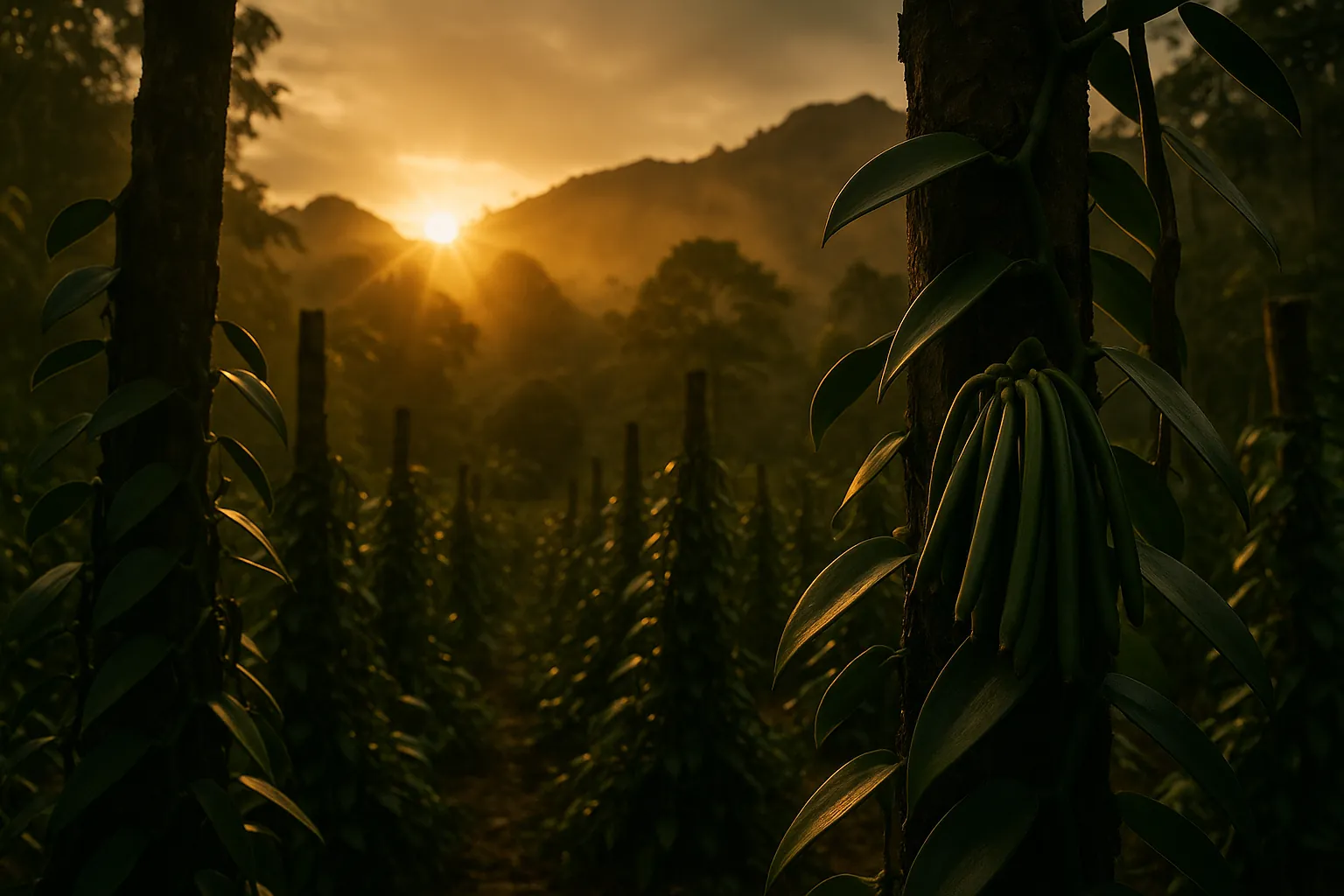

- All three origins grow the same species, Vanilla planifolia, and cure it the same Bourbon way — hot-water killing, sweating, slow drying and conditioning.
- Madagascar (Sava region) is the benchmark: creamy and sweet, 16–18 cm gourmet at 1.6–2.4% vanillin, one cure a year reaching export condition November to January.
- Uganda (Bundibugyo, Mukono) is the continuity origin: bolder and darker, 15–18 cm gourmet at 1.8–2.2%, extraction lots at 2.0–2.6%, two harvests a year.
- The Comoros (Anjouan, Mohéli, Grande Comore) is the artisanal origin: soft, rounded and floral, 14–18 cm at 1.4–2.0% vanillin, cured in small batches.
- Grade sets moisture, not origin — gourmet beans from all three finish at 30–35%, extraction grades at 20–25%.
- Price posture: Madagascar carries the brand premium, Uganda typically trades at a discount on comparable lab numbers, and Comoros prices on scarcity rather than reputation.
- Only Uganda genuinely diversifies the calendar — the Comoros harvests on Madagascar's rhythm, so it spreads supplier and story risk, not seasonal risk.
Most buyers arrive at vanilla with a two-way question — Madagascar or Uganda — which we answer in depth in our two-origin comparison. The third question comes later, usually from someone who has seen Comoros beans on a competitor's shelf: what are they, and do they belong in the same conversation? They do. The Comoro Islands are part of the original Bourbon belt, and they are the third origin we buy from. What follows is the three-way comparison as we brief it to procurement teams — same species, same curing tradition, three genuinely different beans.
Comoros vs Madagascar vanilla beans: which should a buyer choose?
Choose Madagascar if your specification calls for an 18–20 cm Grade A long bean; our Comoros Grade A range is 14–18 cm. For a standard gourmet bean, compare the actual lots rather than treating the origin name as a quality grade. Both are Indian Ocean Bourbon origins, while Ugandan beans are mainland-grown and must be named as Ugandan. Ask for the lot's length, moisture band and vanillin assay before approving a substitute.
Which of these origins can be labelled Bourbon vanilla?
Bourbon is not a country, and it is not a quality claim. It names a curing tradition and the place it came from: Île Bourbon, today's Réunion, where planters worked out how to cure Vanilla planifolia once hand-pollination made cultivation possible outside Mexico. Strictly read, the historic Bourbon belt is the island group of the south-west Indian Ocean — Réunion, Madagascar and the Comoros. On that reading, Comoros beans are as legitimately Bourbon as any in the trade.
Uganda sits differently. It is mainland East Africa, not an Indian Ocean island, and its vanilla industry is modern rather than colonial. But it grows the same species and cures it the same way, which is why the trade sells Ugandan beans as Bourbon-type and why they behave like Bourbon beans in a kitchen or a maceration tank. The distinction only matters practically when your packaging leans on the appellation — and our answer there is always the same: we ship single-origin, lot-tied beans and name the origin on the paperwork, so your label is a decision you make with the facts in front of you rather than an assumption inherited from a broker.
Which origin has the highest vanillin?
Uganda, at extraction grade. Our Ugandan Grade B lots assay 2.0 to 2.6% vanillin, the highest band in our catalogue. Madagascar gourmet runs 1.6 to 2.4% and Madagascar Grade B 1.8 to 2.6%, so the two mainstays overlap at the top. The Comoros sits gentler at 1.4 to 2.0% — a real difference, and one that reads as softness rather than weakness in a finished product.
Origin, though, only sets an expectation. Vanillin is a per-lot property measured by HPLC on a representative sample, and a well-cured Comoros lot can land above a rushed Malagasy one. That is why we quote against a lot with its assay attached rather than against an origin average — the number worth acting on is the one on the lab report travelling with the beans you are buying.
How do the three flavour profiles actually differ?
Madagascar is the reference profile — creamy, sweet, rounded, the taste most consumers mean when they say vanilla, and the profile flavour houses calibrate against. Uganda leans bolder and darker, with a chocolatey, faintly earthy weight that holds up against cocoa, coffee and caramel where a gentler bean would disappear. The Comoros is the quietest of the three: floral, soft-edged, classically Bourbon in character but at lower intensity — which is what a small-batch paste or a delicate custard benefits from.
Vanillin alone explains none of this. A cured bean carries hundreds of aroma compounds, and the balance among them is built by the cure — the sweating cycles, the patience of the drying, the months of conditioning. Origin shapes that balance because curing culture differs from place to place; it does not dictate it.
How do the three harvest calendars line up?
Madagascar picks green pods from June to September, district by district, with the new cure reaching export condition from roughly November to January. The Comoros harvests on much the same rhythm, because the islands share the same latitude band and monsoon pattern. Uganda's equatorial climate gives two flowering cycles and two harvests a year, around December–February and June–August, putting fresh cure on the market in Madagascar's quiet months.
This is the most under-appreciated point in the three-way comparison, and it cuts against the assumption that more origins automatically means less risk. A Madagascar-plus-Comoros programme buys two origins but one calendar, both in the same corner of the Indian Ocean, so a bad cyclone season or a weak flowering can press on both at once. Uganda is the genuine hedge. If your reason for adding a third origin is continuity of supply, Uganda does that work; the Comoros diversifies your supplier base and your story instead.
What do calibre, appearance and moisture tell you?
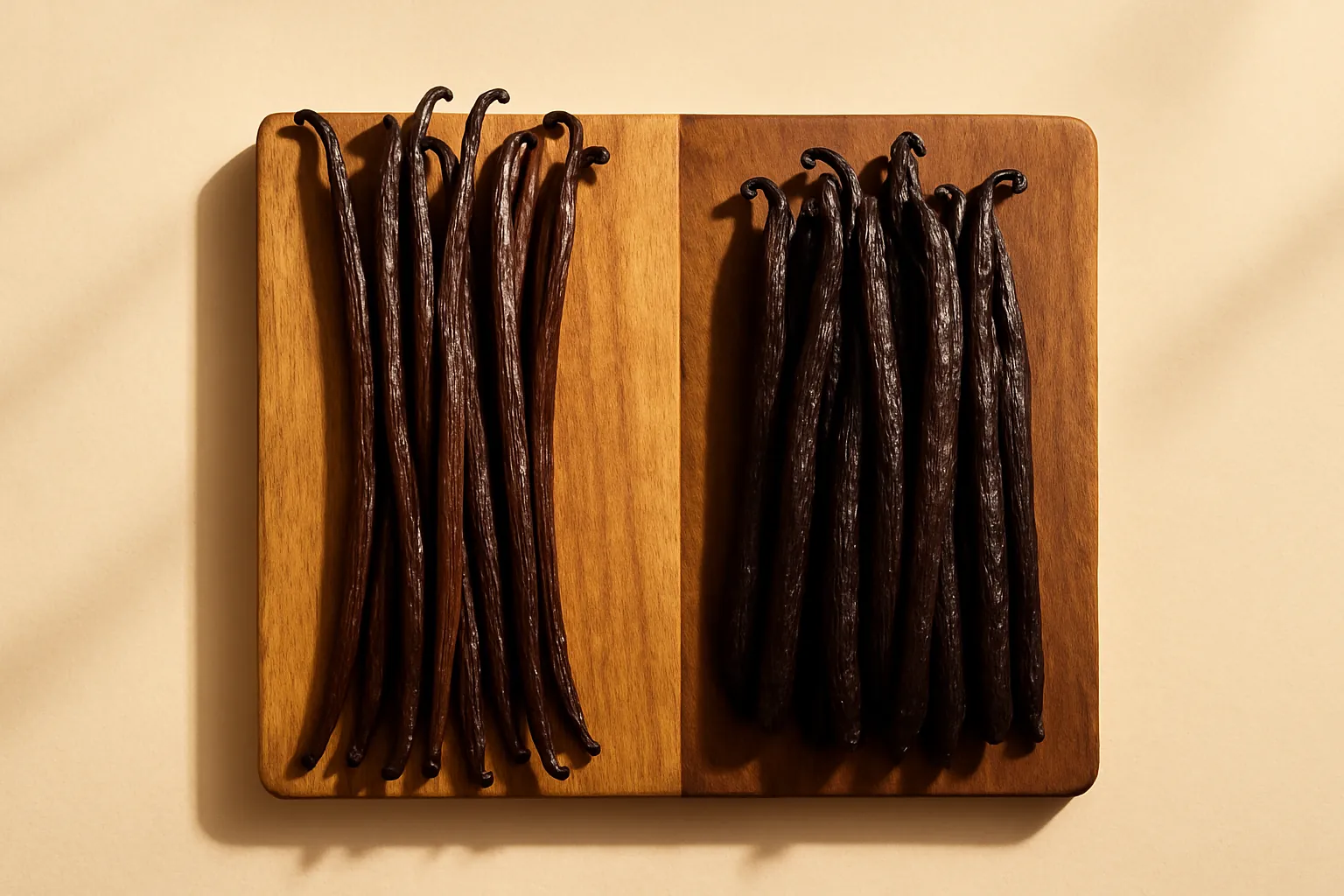
Moisture is set by grade, not by origin. Gourmet beans from all three finish at 30 to 35% — supple, oily, pliable enough to knot — while extraction grades are cured down to 20 to 25% for storage stability and efficient maceration. Anyone quoting a moisture band by origin rather than by grade is guessing. Appearance follows the cure rather than the map in the same way: a well-cured bean from any of the three is dark and supple, while reddish streaks and a drier feel mark extraction grades everywhere.
Calibre is where the origins separate. Madagascar offers the widest choice and the only routine access to premium 18–20 cm beans, which is why display-led retail lines start there; its standard gourmet band is 16–18 cm. Uganda typically runs 15–18 cm gourmet and 13–16 cm extraction. Comoros beans come in at 14–18 cm and vary more between batches, simply because the lots are small and artisanally cured — the honest trade-off for buying from a small origin. Agree the calibre band lot by lot and there are no surprises; assume a fixed length across the season and there will be.
Should I buy Comoros vanilla?
Buy it if you sell an origin story and want one that is not already on every competitor's shelf; if you make small-batch extract, paste or gift lines where a few dozen kilograms is a meaningful run; or if you want to diversify inside the Bourbon appellation without moving your label to a mainland origin. The soft, floral profile suits products where vanilla is the lead note rather than a backdrop.
Look elsewhere if you need large repeatable volume on a fixed monthly schedule, if your specification demands consistent 18 cm-plus beans, or if you price purely on vanillin per dollar — Uganda wins that comparison and it is not close. With the Comoros the binding constraint is allocation rather than price: the crop is small, the lots are small, and good batches are spoken for early. Buyers who reserve during the cure get the beans.
How do the three compare on price?
Madagascar sets the world reference and carries two premiums that have nothing to do with what is in the bean: the weight of the Bourbon name in buyer habit, and a risk premium because the Sava region sits in a cyclone corridor. Uganda carries neither, so a Ugandan lot matching a Malagasy one on vanillin, moisture and cure quality still typically trades at a discount — market structure, not a quality verdict. The Comoros prices on a third logic: scarcity. Small crop, small lots and artisanal curing mean Comoros beans usually carry a premium over comparable Ugandan lots.
The useful discipline is to stop comparing origins and start comparing lots. Two quotes are only comparable when both name a grade, a calibre band, a moisture band, a vanillin range with the lab method behind it, and a packing format. Once those are on the table, the origin premium becomes a number you can accept or decline.
The three origins side by side
- Flavour lean — Madagascar: creamy, sweet, classic. Uganda: bold, chocolatey, high-impact. Comoros: soft, floral, gentle.
- Vanillin — Madagascar 1.6–2.4% gourmet and 1.8–2.6% extraction; Uganda 1.8–2.2% gourmet and 2.0–2.6% extraction; Comoros 1.4–2.0%.
- Moisture — set by grade across all three: 30–35% for gourmet, 20–25% for extraction.
- Calibre — Madagascar 16–18 cm with an 18–20 cm premium line; Uganda 15–18 cm gourmet, 13–16 cm extraction; Comoros 14–18 cm with more batch variation.
- Harvest — Madagascar green pods June–September, cure November–January; Comoros roughly June–September; Uganda twice yearly, December–February and June–August.
- Price posture — Madagascar carries the brand and cyclone premium; Uganda usually trades at a discount on equal lab numbers; Comoros prices on scarcity.
- Best first use — Madagascar for flagship retail and patisserie; Uganda for extraction economics and year-round continuity; Comoros for origin-story lines and small-batch craft.
“Madagascar anchors the label, Uganda anchors the calendar, and the Comoros anchors the story. Buyers get into trouble when they ask one origin to do all three jobs.”
- Joachim Mbwana, Sourcing Lead
How should a buyer combine the three?
Start with the job each origin is genuinely good at. If your product leads with provenance and classic flavour, Madagascar Grade A is the opening position and the label can say Sava. If you price on vanillin per dollar, benchmark Uganda Grade B against your current supply and let the assay make the argument. If you want a limited line or a gift range that reads as discovery rather than substitution, take a Comoros allocation and treat it as the small, deliberate thing it is.
At programme scale, qualify all three at once. Sampling three origins costs little more than sampling one, and it turns the annual price conversation from a single negotiation into a set of options. Every lot we ship is single-origin, tied to its district and curing window, and lab-tested at origin for vanillin and moisture — so three origins never means a blend of unknown parts. Tell us your grade, volume band and destination, and we will send lot-tied samples from all three with their assays.
Compare the three origins directly
- Wholesale vanilla beans supplier overview- grades, origins, MOQ and shipping in one place
- Madagascar Grade A gourmet beans- Sava region · 16–18 cm · 1.6–2.4% vanillin
- Uganda Grade A gourmet beans- Bundibugyo & Mukono · two harvests a year
- Comoros Bourbon vanilla beans- Island lots · 14–18 cm · 1.4–2.0% vanillin
- Madagascar vs Uganda, in depth- The two-origin comparison, unpacked
- Vanilla bean grades explained- Grade A gourmet vs Grade B extraction
- Request lot-tied samples- Three origins, one export desk
Related reading

Leave a Comment
Your email address will not be published.