
At a glance
- Every flower is pollinated by hand in a single morning — the orchid has no natural pollinator in Madagascar or Uganda, and no machine substitute anywhere.
- Curing runs three to six months on daily judgment — kill timing, sweat-box checks by feel and smell, morning-by-morning drying calls.
- Grading is a composite call by hand and eye — calibre, suppleness, oiliness, colour and aroma, bean by bean.
- That labour is the price: 5–6 kg of hand-set green pods and months of skilled handling stand behind every cured kilogram.
- Technology verifies rather than replaces — moisture meters, HPLC vanillin assays, vacuum packing and lot-tied records prove what human hands produced.
- AI earns its keep on the export desk — documents, schedules and traceability records — not in the curing yard.
Half the trade press covers what AI will automate next; the other half, what it already has. Vanilla belongs to neither half. No crop in our portfolio demands more human labour per kilogram, and it is still grown, cured and graded by hand — not out of sentiment, but because nobody has built a machine that can do the work. That fact explains vanilla's price structure, quality risks and supply behaviour better than any market report.
Why can't machines pollinate vanilla?
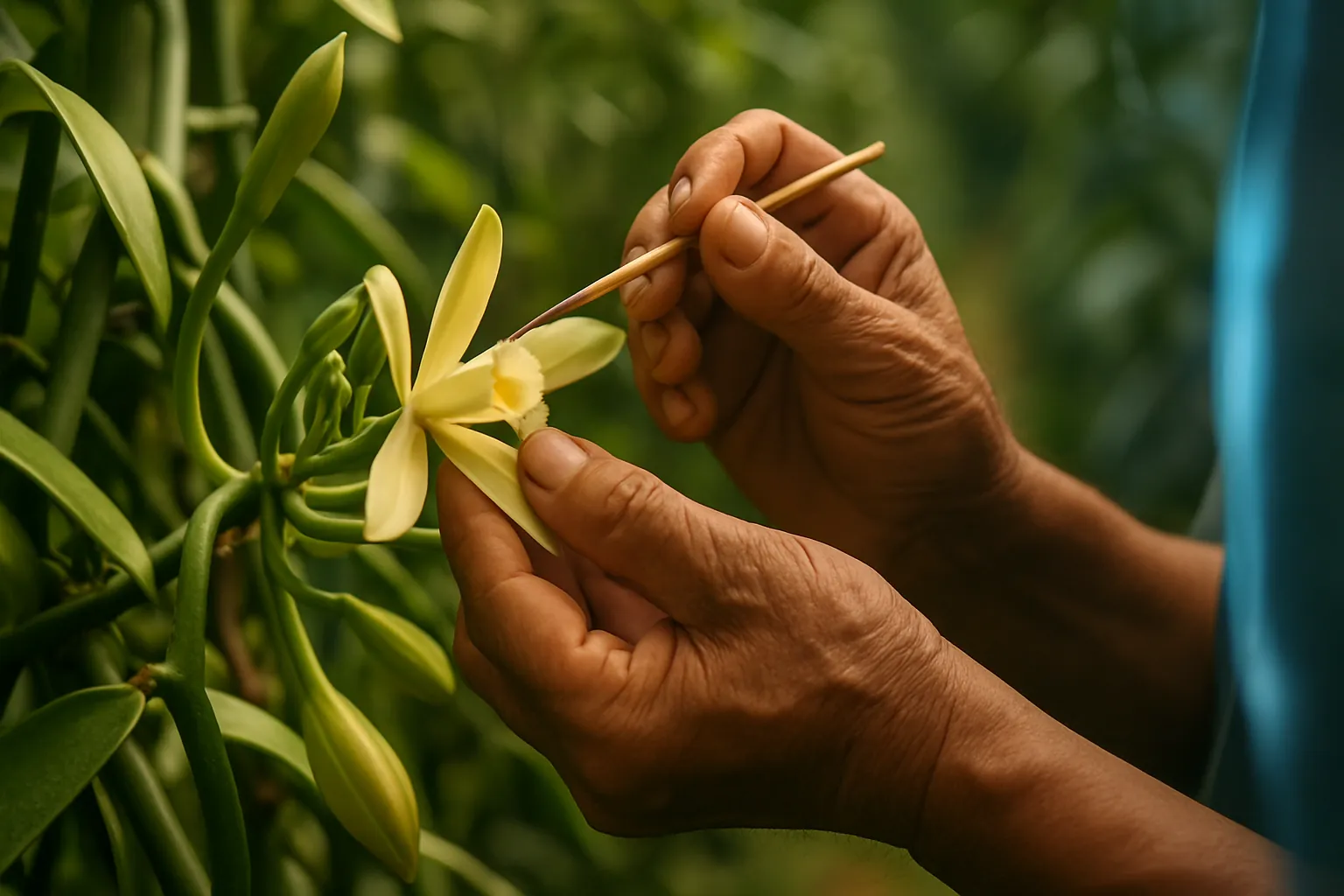
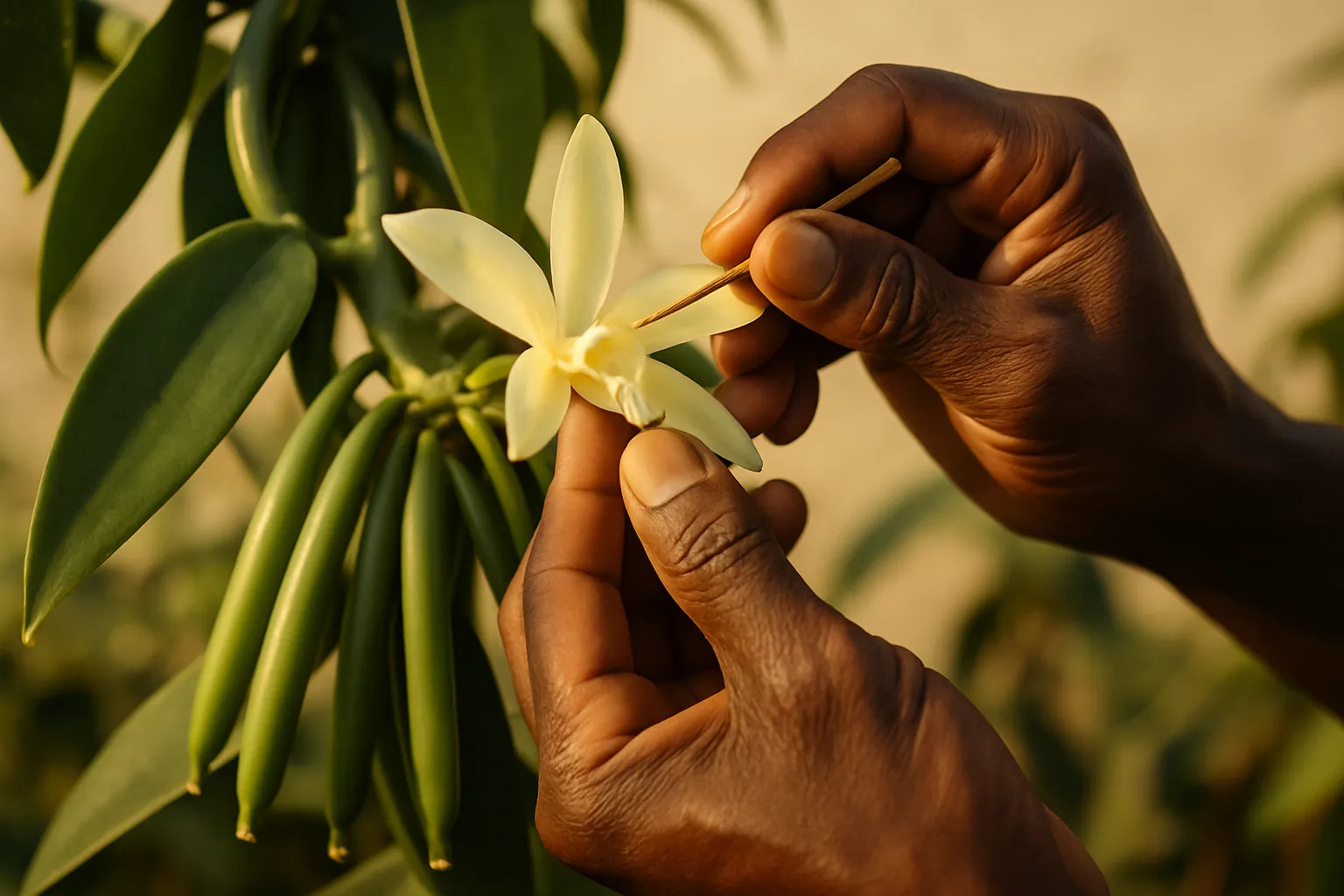
Because pollination is a same-morning judgment call repeated across millions of blooms on smallholder plots. The orchid has no natural pollinator in Madagascar or Uganda; each flower opens once, for a single morning, and wilts unpollinated by early afternoon. A worker lifts the membrane inside the flower with a sliver of bamboo and presses its parts together — several hundred flowers each morning of the flowering season.
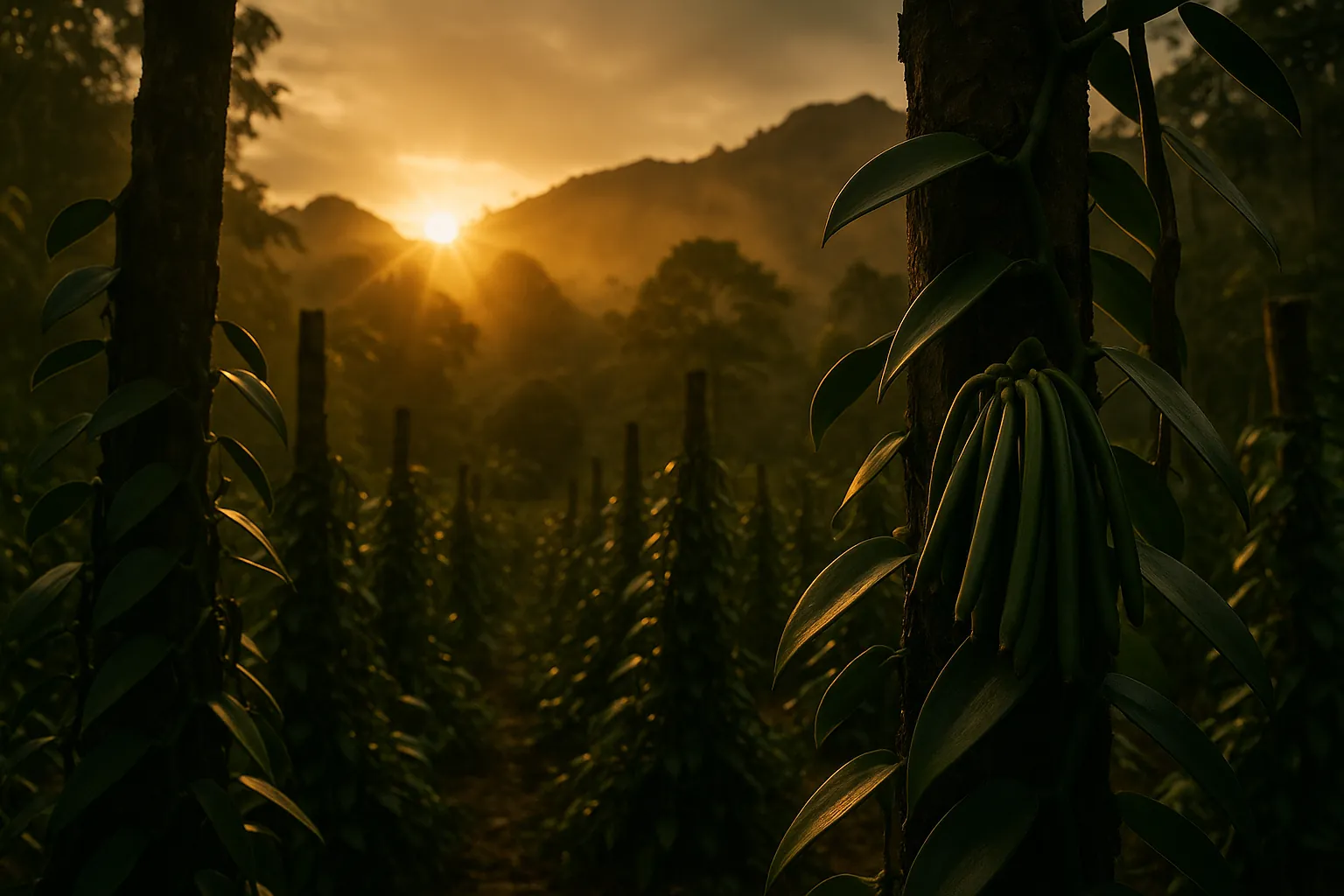
What defeats machinery is not just the dexterity. Growers also decide which flowers to set and which to skip, vine by vine — over-pollination produces thin, short pods; disciplined pollination produces the fat 16–20 cm calibres gourmet buyers pay for. That is a quality decision embedded in a physical task, performed on vines trained up living tutor trees across scattered village plots. Our pollination-to-cure guide walks the full calendar; the short version is that a vanilla bean exists only because a specific person chose to make it, one morning, nine months before harvest.
Why does vanilla curing resist automation?
Because curing is not a fixed process you could program — it is months of daily, lot-by-lot decisions where the feedback that would train a machine arrives months too late. Our season guide walks the four stages in full; what matters here is where the judgment sits:
- The kill — nominally two to three minutes at 63–65°C, but the real call is the curer's: pod maturity shifts the timing basket by basket; slightly too hot destroys the enzymes, too cool cures unevenly.
- The sweat — beans leave the wool when they feel and smell right, not when a timer rings: curers press the beans, judge the colour and decide — back into the box, or out into the sun.
- The slow dry — every morning for three to four weeks, someone weighs the weather against the bean and gives each rack sun or shade. Rushing this stage is the most common cause of mould claims.
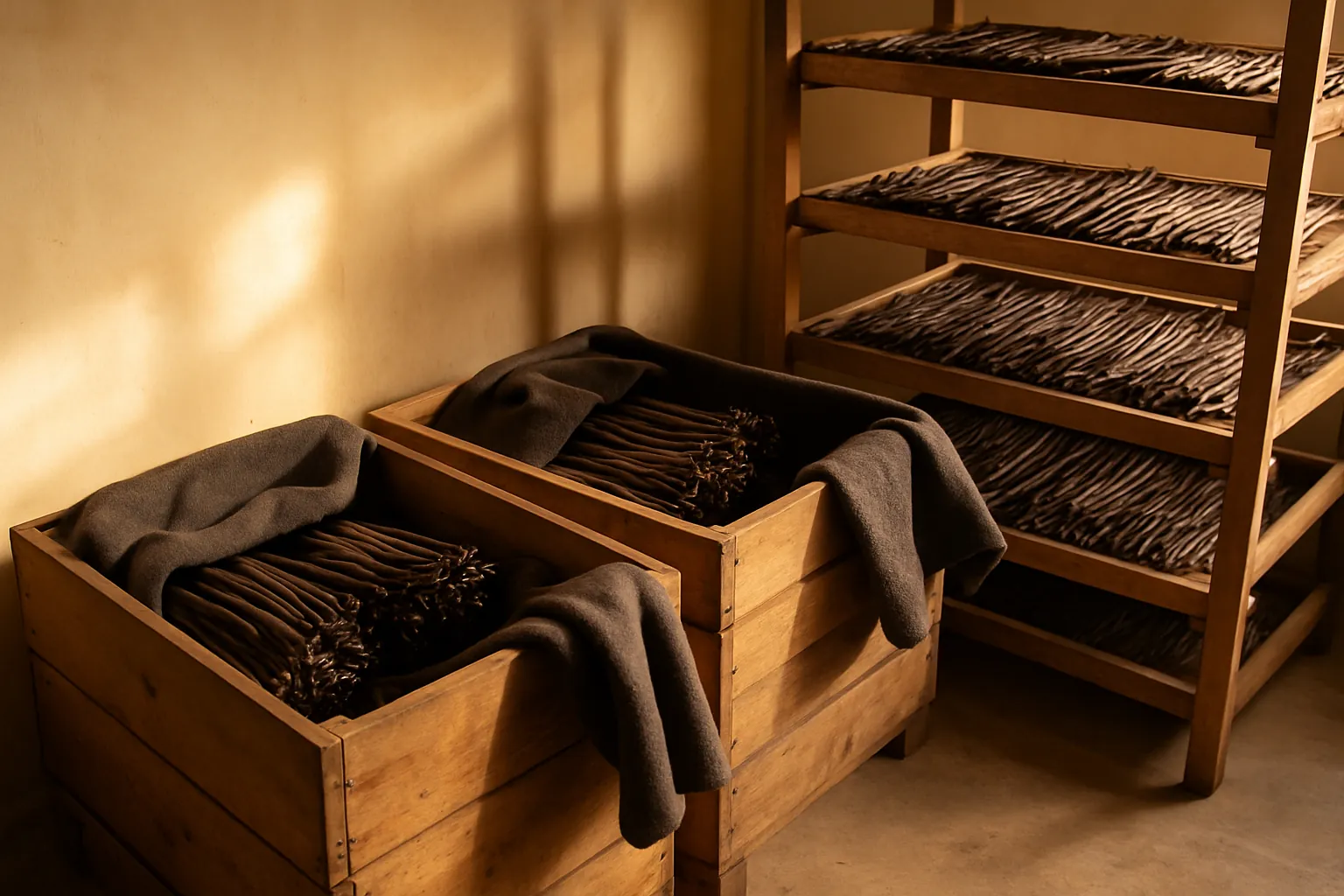
- Conditioning — for one to three months, curers open the lined boxes, smell the beans and re-sort them, pulling problems out of the lot before they spread.
No sensor suite replicates that. The inputs vary lot by lot; the right decision differs for a fat Sambava bean and a slim Vohémar one; and errors surface months later — often in an importer's warehouse — starving any learning system of the fast, labelled feedback it would need. Add thousands of smallholder curers spread across villages rather than one factory floor, and the automation case collapses.
Could a machine grade vanilla beans?
Not with today's technology. A grade is a composite judgment: length, plumpness, whether the bean wraps around a finger without cracking, surface oil, colour, aroma, a dozen defect checks — assessed together, in seconds, by a sorter who has handled tonnes.
Machines measure single dimensions well: a camera can sort by length, a meter reads moisture in seconds. What none delivers is the combined call — this bean is gourmet, this one TK, this one extraction — with the consistency of an experienced grading table. So the trade runs it the honest way round: humans grade, instruments verify. Every lot we ship is hand-graded at origin, then proven with a moisture reading and an HPLC vanillin assay before it is priced.
Is hand labour the reason vanilla costs so much?
Largely, yes. Every cured kilogram starts as five to six kilograms of green pods — each pod from one hand-pollinated flower — and then absorbs three to six months of skilled daily labour before it is graded, again by hand.
That is why vanilla cannot be made meaningfully cheaper without being made worse. The available corners are all human ones — pollination discipline, kill timing, drying patience — and every one shows up later as thin calibres, flat aroma or mould. When a quote looks too good, labour is what was removed. Our guide to what drives Bourbon vanilla prices, linked below, unpacks the full machinery.
Where does technology actually help the vanilla trade?
Everywhere the bean needs to be measured, protected, tracked or papered — after the human work is done. The modern trade is not anti-technology; it puts the machines on the verification side of the line:
- Moisture meters — the reading behind every moisture band on a spec sheet, and the fastest way to catch an under-cured lot before it ships.
- Vanillin assays — HPLC laboratory analysis turns aroma into a number, and that number prices every extraction lot we sell.
- Vacuum packing — 1 kg gourmet pouches and 5 kg extraction cartons hold a 30–35% moisture bean stable through transit; the food-grade pouch has done more for vanilla quality than any algorithm.
- Lot traceability — district, curing window, assay and packing date tied to a lot number that follows the beans to your goods-in bench.
- AI on the export desk — document packs, shipping schedules, records and correspondence are exactly the repetitive, text-heavy work language tools do well. We happily save hours there; none of them were curing hours.
“Machines are honest witnesses and hopeless curers. We use instruments to prove what a bean is — never to decide what it becomes.”
- Asha Ngonyani, Quality Manager
That division of labour is the honest summary of this trade. Our beans are grown, cured and graded by people — grower and curer networks in Madagascar's Sava region and Uganda's Bundibugyo and Mukono districts — and consolidated at their origin gateways, never processed elsewhere en route. When you buy vanilla, hands are what you pay for; the paperwork — from moisture meter to export desk — just proves it.
Related reading and products
- Madagascar's vanilla season: pollination to cure- The hand-made calendar in full
- What drives Bourbon vanilla prices- Where the labour lands in the quote
- Vanilla flavour chemistry for buyers- What the instruments measure — and miss
- Madagascar Grade A gourmet beans- Hand-graded 16–18 cm · vacuum-packed
- Uganda Grade A gourmet beans- Hand-graded gourmet, origin discount
Related reading
Leave a Comment
Your email address will not be published.