
Every vanilla contract negotiates around one number — vanillin content — and every experienced flavourist will tell you that number is only the beginning of the story. Understanding what vanillin measures, what it misses, and why natural vanilla still commands a premium over a molecule that can be synthesised for a fraction of the price will make you a sharper buyer of both.
Vanillin: the benchmark molecule
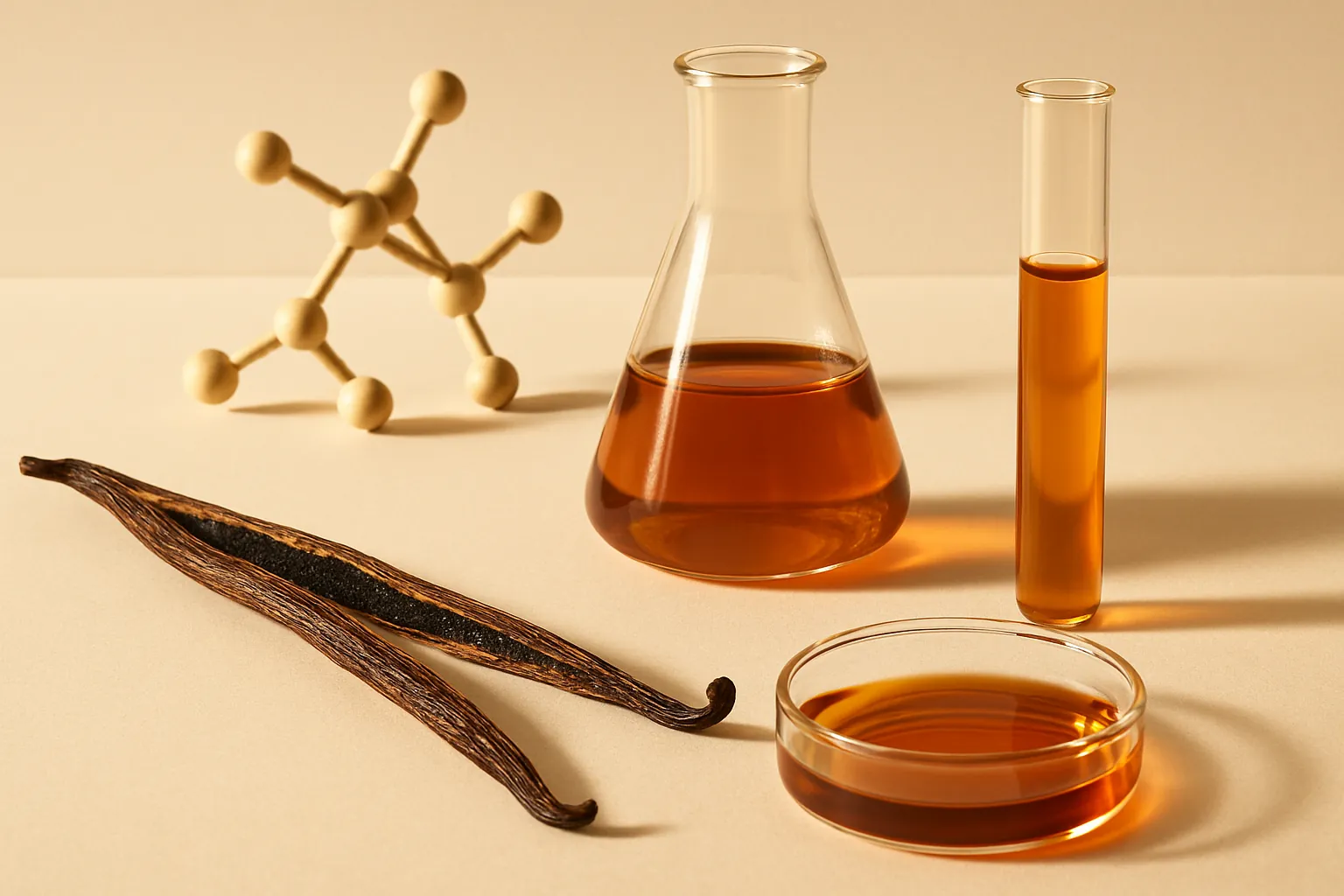
Vanillin (4-hydroxy-3-methoxybenzaldehyde) is the dominant aroma compound in cured vanilla and the standard proxy for flavour strength. In the green pod it exists as glucovanillin, a flavourless glucoside; the curing process — killing, sweating, drying — releases enzymes that cleave the sugar and liberate free vanillin. A well-cured Bourbon bean typically assays between 1.2 and 2.4% vanillin by dry weight; our gourmet lots run 1.6–2.4% and our Ugandan extraction beans reach 2.6%. The industry-standard measurement is HPLC — high-performance liquid chromatography — on a representative sample, and that is the method behind the assay figure on our lab reports.
Vanillin content is a fair basis for pricing extraction beans, because in a maceration tank flavour per kilogram is exactly what you are buying. But two lots with identical vanillin can smell noticeably different — and that difference is everything else in the bean.
The other two hundred compounds
Analytical studies of cured vanilla have identified well over 200 volatile aroma compounds. Individually most sit below sensory thresholds; together they build the roundness that separates natural vanilla from vanillin solution. The ones flavour buyers hear about most:
- 4-Hydroxybenzaldehyde — vanillin's quieter partner; adds a mild, sweet-almond nuance and is routinely reported alongside vanillin on full assays.
- Vanillic acid and 4-hydroxybenzoic acid — sour-balsamic backbone notes; their ratios are also used analytically to detect adulteration.
- Guaiacol and creosol — smoky, phenolic notes; prominent in some cures and origins.
- Anisyl compounds (anisaldehyde, anisyl alcohol) — the delicate floral-sweet top notes prized in Bourbon vanilla.
- β-Damascenone — a rose-fruity trace compound with an extremely low odour threshold; tiny amounts shape the bean's perceived richness.
“Synthetic vanillin is one instrument playing one note, perfectly. A cured bean is the orchestra — slightly different every season, which is exactly why brands pay for it.”
- Neema Kessy, Nutrition & Editorial Lead
Natural vs synthetic: the commercial reality
More than 95% of the world's vanilla flavour is synthetic vanillin, produced from guaiacol or from lignin, at a cost far below bean-derived flavour. It is chemically identical to natural vanillin and entirely safe. What it cannot do is deliver the minor-compound complexity above — or the label. In the EU and the US, a product flavoured with synthetic vanillin cannot be labelled 'natural vanilla flavour', and 'vanilla' ice cream made with beans commands a different shelf position than 'vanilla flavoured'. For many of our buyers, the bean is as much a labelling decision as a sensory one.
Why origin and cure shape the profile
The minor-compound balance is not fixed by the plant alone — it is shaped by where the vine grew and how the bean was cured. Madagascar lots lean creamy and sweet, with the anisyl top notes the Bourbon reputation is built on; Ugandan beans run bolder and darker, with more of the smoky-phenolic register. Within one origin, curing decisions move the needle too: a longer conditioning develops rounder, deeper aroma, while a rushed cure leaves a bean that assays respectably on vanillin yet smells thin. This is why we tell buyers that the assay qualifies a lot and the nose selects it — and why our samples always come from the specific lot on offer, never from a showcase drawer.
Reading a lab report like a flavourist
- Vanillin % — flavour strength per kilogram; the pricing anchor for extraction grades.
- Moisture % — determines suppleness (gourmet) and effective flavour concentration (a wetter bean dilutes its own assay).
- Vanillin-to-moisture together — the honest comparison between two quotes; a cheap wet bean can be dearer per unit of flavour than an expensive dry one.
- Origin and cure batch — the proxy for the minor-compound profile that no single number captures. Sample and taste before committing to volume.
Our advice to procurement teams is simple: price extraction beans on vanillin, choose gourmet beans by sample, and insist on the lab report either way. Every lot we ship carries an independent vanillin and moisture assay, so the chemistry you are buying is on paper before the beans leave origin.
Related reading

Leave a Comment
Your email address will not be published.