

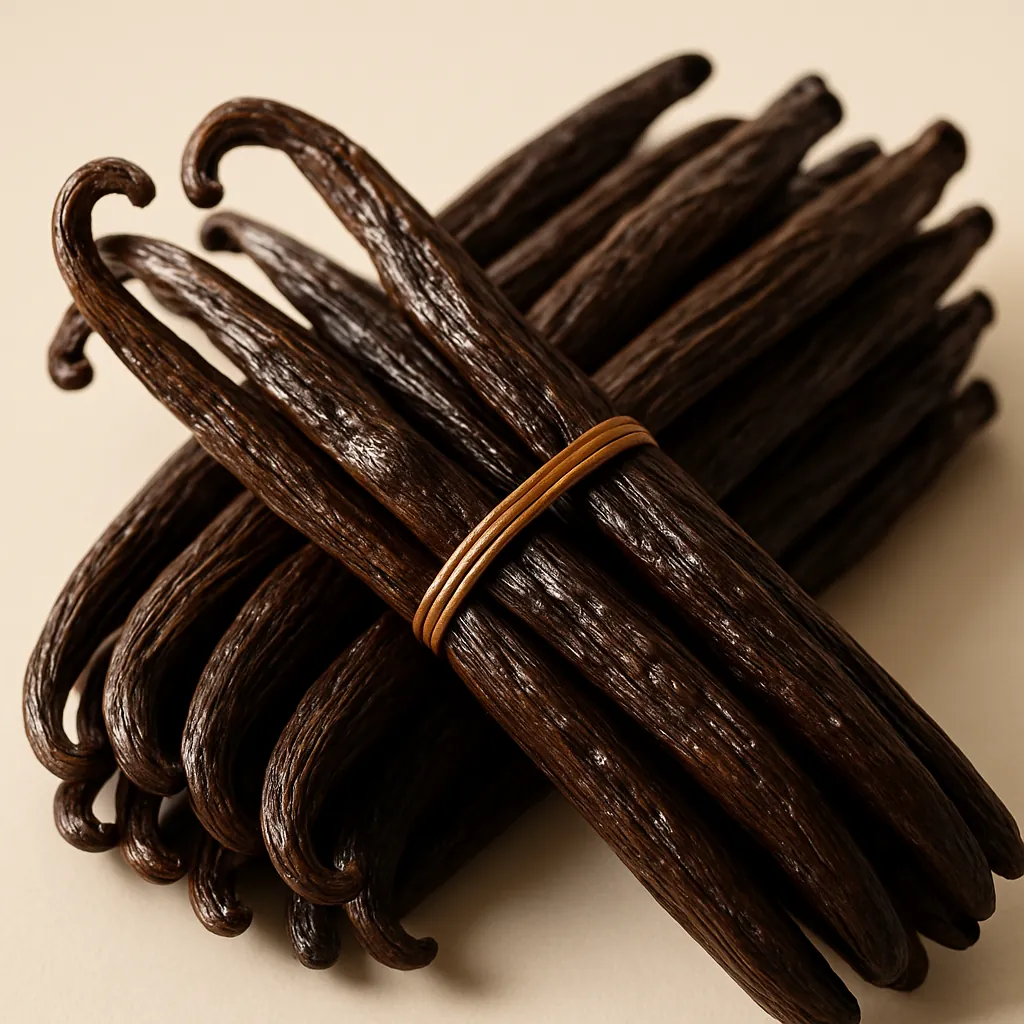
- Trial orders start at 5–10 kg — enough beans for a full quality evaluation, typically air-freighted within days of contract.
- Commercial orders usually run 25–100 kg, vacuum-packed in 1 kg gourmet pouches or 5 kg extraction cartons.
- Contract programmes begin around 250 kg and up, normally staged across the season from reserved lots.
- There is no container to fill: a single pallet of gourmet vanilla can carry the value of a container of bulk produce.
- Vanilla is a kilogram-scale crop by nature — it takes 5 to 6 kg of green pods to cure 1 kg of finished beans.
- Every band starts the same way: a lot-tied sample with its vanillin and moisture assay before any volume commitment.
- Shipments despatch from origin gateways — Toamasina for Madagascar lots, Mombasa or Entebbe air for Uganda lots — under one export desk.
The minimum order quantity for wholesale vanilla beans is measured in kilograms, not containers. In our programme, trial orders start at 5 to 10 kg, commercial orders run 25 to 100 kg, and contract programmes begin around 250 kg per season. That makes vanilla one of the most approachable agricultural commodities to qualify: a buyer can test a supplier's lot discipline end to end for a modest sample budget, then scale on evidence rather than on faith.
Why is vanilla's MOQ quoted in kilograms, not containers?
Because vanilla concentrates value instead of volume. A serious cashew or sesame order fills a 20-foot container; a serious vanilla order might weigh 100 kilograms, sit on one pallet, and still carry comparable commercial value. Freight never forces a container-sized commitment, so the economic floor sits where fixed shipment costs — export documentation, phytosanitary certification, the lab assay and handling — stop dominating the per-kilogram price.
In practice that floor is around 5 kg. The same document pack — certificate of origin, phytosanitary certificate, independent lab report — travels with a 5 kg parcel as with a 500 kg programme, so below that line the paperwork can cost more per kilogram than the curing did. From roughly 25 kg upward, the fixed overhead fades to a low single-digit share of the invoice.
What do the three volume bands look like?
Three bands cover almost every buyer we supply — trial, commercial and programme — and what changes between them is allocation and pricing structure, not quality:
- 5–10 kg — trial. One grade, one lot, air freight or courier. Runs your entire workflow — sample confirmation, customs, arrival QA, a production test — with modest capital at risk. Spot pricing applies.
- 25–100 kg — commercial. The re-order band for bakeries, extract houses and distributors. Mixed formats are practical (gourmet pouches plus extraction cartons in one shipment), and air freight remains economic to most destinations.
- 250 kg+ per season — programme. Reserved lots from the new cure, staged monthly or quarterly despatches, firmer pricing and first call on premium calibres. At this band your volume starts to shape what we hold back at origin.
How does vacuum packing change the economics?
Vacuum packing is what makes kilogram-scale trade possible at all. Gourmet beans travel in 1 kg food-grade vacuum pouches and extraction beans in 5 kg vacuum cartons — units small enough to compose any order size, stable enough to hold a 30–35% moisture bean safely through transit, and dense enough in value that air freight stays economic for orders up to a few hundred kilograms.
Container crops run the opposite maths: value per kilogram is low, so the economics only work when a container's fixed costs spread across many tonnes — which is why their MOQs start at a full container. Vanilla inverts the ratio — high value per kilogram, small volumes, freight a minor line on the invoice. That is why our vanilla quotes are per kilogram FOB, with the freight mode chosen per order rather than dictated by a box.
“Vanilla is the one commodity where we tell first-time buyers to order less. A 10-kilogram trial that proves the lot discipline is worth more than a 100-kilogram order that arrives on faith.”
- Daniel Mahenge, Logistics Coordinator
Should you sample before committing to volume?
Always — and a serious supplier makes it easy. Before any order band, we send a representative sample drawn from the actual lot on offer, accompanied by that lot's vanillin and moisture assay. The trial band then exists so sampling can scale: 5–10 kg supports real production tests — an extraction run, a bake trial, retail packaging — that a 100-gram sample never could. Buyers who follow that ladder almost never face an arrival surprise, because every step was verified against the same lot number.
Can vanilla ship alongside a cashew or sesame order?
Commercially, yes; physically, the beans despatch from their own origin. Our vanilla is packed and shipped from Toamasina for Madagascar lots and routed via Mombasa or flown ex-Entebbe for Uganda lots, while our cashew and sesame programmes ship from Tanzanian ports — so the cartons rarely share a container. What does consolidate is everything around them: one export desk, one contract and documentation workflow, despatch windows aligned so shipments land together, and programme terms that recognise your combined volume across all three commodities.
Tell us your grade, target band and destination, and we will quote a trial and a commercial scenario side by side, with freight mode and lead time for each — so the first decision you make is an informed one, at the smallest sensible scale.
Related reading and products
- Wholesale vanilla beans supplier overview- grades, origins, MOQ and shipping in one place
- How to import vanilla beans- The seven-step workflow a trial order tests
- Packing & shipping vanilla beans- Pouches, cartons, air vs sea in depth
- Madagascar Grade A gourmet beans- 1 kg vacuum pouches · trial-friendly
- Uganda Grade B extraction beans- 5 kg cartons · vanillin 2.0–2.6%
Related reading

Leave a Comment
Your email address will not be published.